
The way people are working is changing at an unprecedented rate. At the same time, advances in artificial intelligence, automation, digitization, and data-driven decision-making are transforming industries and spawning new job roles.As businesses evolve their operations, their expectations of graduates continue to evolve as well. Many employers want professionals who can combine academic learning with future-ready skills.
A university degree will remain the cornerstone of intellectualism, critical thinking, and subject-matter expertise, but its practical applications will be the measure of its success in the coming years. As a result, there is a growing focus on skill-integrated education, hands-on learning, and industry exposure so that students graduate not merely with degrees but with the skills to adapt to a changing environment.
Adding to this, Dr. Somnath P. Patil, Pro-Chancellor, Dnyaan Prasad Global University (DPGU) by Dr. D.Y Patil Unitech Society says, “The future workforce will require a blend of strong academic foundations and the ability to adapt to emerging technologies and industry needs. Higher education institutions have a crucial role to play in nurturing problem-solvers, innovators, and lifelong learners. As new fields continue to emerge, students must be equipped with both domain knowledge and practical skills that enable them to contribute meaningfully from day one of their professional journey.”
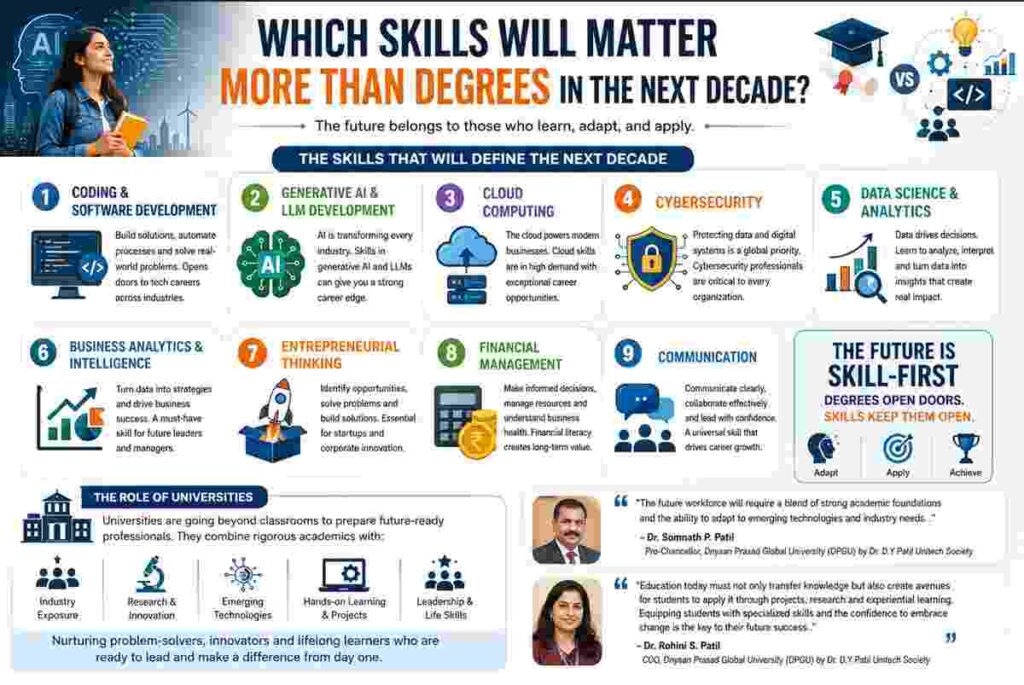
The Skills That Will Define the Next Decade
As industries become more technology-driven and interconnected, certain skills are rapidly becoming a necessity across sectors. This competency is not limited to any one profession but is fast becoming a necessity with professionals in technology, business, healthcare, and finance, with skills such as :
1. Coding & Software Development
Knowing how to code is a useful skill. One can automate current processes and address business problems through code. Students now learn creative thinking and logical reasoning through coding to solve problems. These pathways, after all, lead graduates to openings in software development, product engineering, and other technical fields.
By enrolling in a B.Tech in CSE, students study strong programming and software development fundamentals. They can also improve these skills through software development and emerging technology programs with industry exposure.
2. Generative AI & LLM Development
Artificial Intelligence is changing how organizations function, innovate, and decide. From robots to disruptors, generative AI and large language models have become ubiquitous across industries and applications. AI literacy can be a major career advantage for students as organisations continue to invest in intelligent technologies.
With a B.Tech in Artificial Intelligence & Machine Learning, students gain a solid foundation in AI, machine learning, and intelligent systems. Other courses on advanced AI applications can enhance learners’ skills in this rapidly growing field.
3. Cloud Computing
The foundation of most businesses today rests on the cloud, powering everything from data storage to application management. There is a strong demand for new professionals with cloud computing skills, and the outlook for future careers in this field is very promising.
Students in the B.Tech in Computer Science & Engineering program learn the basic building blocks for understanding cloud technologies and can dive deeper into cloud computing through a variety of specialized programs and certifications that carry significant industry recognition.
4. Cybersecurity
In the world of digitally integrated systems, keeping data and digital technology infrastructure secure has become a top priority for organizations worldwide. The field offers students ample opportunities and helps them grow as individuals by deepening their understanding of risk management, digital security, and the ethics of technology.
A B.Tech in Cyber Security provides an understanding of network security, hacking ethics, data security, etc. Moreover, students can pursue B.Tech programs in cybersecurity and digital forensic science.
5. Data Science & Analytics
In the data era, decision-making is driven by data, and learning to analyze and interpret it has become essential for organizations. Data science facilitates better decision-making, identifies trends, and improves performance. The skill is highly adaptable to students, irrespective of the industry – technology, healthcare, business, or research.
The B.Tech in Data Science course offers an introduction to machine learning, prediction, modelling, and analytics. Furthermore, students can deepen their knowledge of data science and analytics.
6. Business Analytics & Intelligence
Today, organizations depend heavily on data-driven decision-making. Business analytics helps turn raw data into practical strategies, making companies more successful and efficient. For students interested in management and leadership, it combines strategic thinking with logical analysis.
The MBA in Business Analytics equips students with data visualization, interpretation, and strategic analysis skills, as well as strategic planning. Specialized analytics programmes can further enhance these capabilities.
7. Entrepreneurial Thinking
Entrepreneurial thinking is the ability to identify opportunities, solve problems, and act on them. These skills are increasingly valued not only in startups but across various fields. This mindset fosters innovation, leadership, adaptability, and confidence in navigating change.
This attitude cultivates creativity, leadership, resilience, ideation and decision making in students. Programs like the Bachelor in Business Administration (BBA) and Master in Business Administration (MBA) help improve business acumen, problem-solving abilities, and leadership qualities. Furthermore, students may also acquire the needed skills for building and scaling a new idea through the Entrepreneurship certifications provided in the MBA courses along with startup incubation and innovation initiatives.
8. Financial Management
The ability to make informed decisions, manage resources properly, and interpret a business’s health requires sound financial management skills. A career in the business world – be it business, finance, entrepreneurship, or leadership roles – having financial literacy can go a long way in helping students develop long-term strategic vision.
9. Communication
In an increasingly collaborative workplace, communication is one of the most valuable skills. The ability to communicate clearly, work well with others and present confidently is important across industries.
Strong Communication Skills Increase Employability, Possibility of Leadership and Professional Confidence. MBA programmes, which include Business Communication, help students in developing writing, presentation and people skills. Furthermore, enrolling in specialised language programmes for foreign languages like German and Japanese can enhance student’s international appeal and facilitate effective communication in the academic and professional arena.
Reflecting on the importance of holistic skill development, Dr. Rohini S. Patil, COO, Dnyaan Prasad Global University (DPGU) by DR. D.Y Patil Unitech Society, says, “The future professionals who will be successful are those who have technical knowledge as well as human skills like communication, collaboration, adaptability, and leadership. Education today must not be confined only to knowledge transfer but also to creating avenues for students to apply it through projects, industry fitment, research-based learning, and experiential learning. Essentially, preparing the student for their future job means equipping them with specialized skills and the confidence to embrace change.”
The Role of Universities
The role of the university is now about shaping the students to face and contribute in the workplace of the future. Today’s universities are bringing industry exposure, research, and new technologies into the classrooms, coupled with rigorous academics. Universities today understand the importance of applying knowledge and learning. Universities today are cultivating qualities such as problem-solving, innovation, leadership, communication, and adaptability, thereby nurturing job-ready students who will not only earn degrees but also contribute to innovation and leadership.