
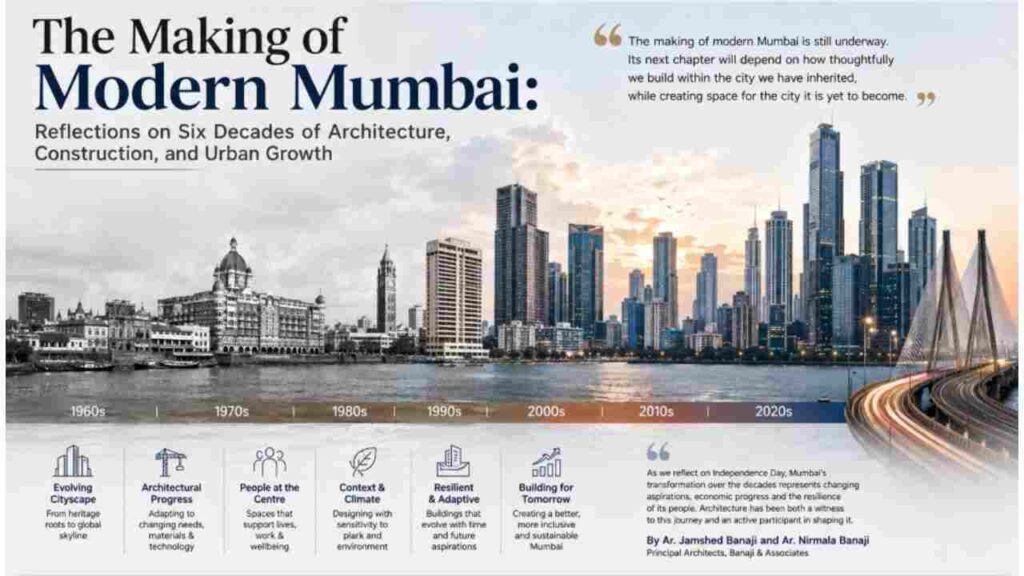
Mumbai has never been a city that stands still. Its architecture reflects this constant movement, shaped by economic change, migration, new technologies, evolving lifestyles, and the growing pressures of limited urban land. Over the past six decades, we have witnessed this transformation closely, not simply as architects, but as participants in the city’s continuing story.
The Mumbai of the 1960s and 70s was defined by a different scale of development. Industrial establishments, individual residences, institutional buildings and emerging commercial spaces formed an important part of the city’s fabric. As Mumbai expanded, architecture had to respond to increasingly diverse requirements. Homes became more compact, workplaces more complex, and commercial and institutional buildings began to demand greater efficiency and flexibility.
One of the most significant changes has been the increasing density of the city. With land becoming more valuable and development moving vertically, the relationship between built form and the surrounding neighbourhood has become increasingly important. A building can no longer be considered in isolation. Its scale, access, circulation, light, ventilation and relationship with the street all contribute to the larger urban experience.
We have also seen a fundamental shift in how people understand the spaces they occupy. Residential architecture has moved beyond providing shelter to creating environments that support multiple aspects of family life. Workplaces have evolved from purely functional environments into spaces that consider collaboration, wellbeing and identity. Retail and hospitality have similarly become more experiential, with material, lighting and spatial planning playing a larger role in shaping how people engage with a space.
Yet, despite these changes, certain fundamentals remain constant. Good architecture begins with understanding. It requires a careful reading of the site, the climate, the people who will use the space and the purpose it needs to serve. Materials are not simply finishes. They influence how a building ages, how it feels and how it belongs to its context. Proportion, natural light, circulation and detailing continue to matter regardless of changing architectural styles.
Mumbai’s growth has also taught us that resilience is not only about technology or infrastructure. It is about creating buildings that can adapt. Spaces need to accommodate changing lifestyles, new forms of work, and evolving expectations without losing their architectural clarity.
Looking at six decades of Mumbai’s development, the greatest lesson is perhaps that architecture must evolve with the city without becoming disconnected from it. The materials and technologies may change. The scale of construction may change. The aspirations of its people will certainly change.
What should remain is an understanding of context, purpose and permanence.
The making of modern Mumbai is still underway. Its next chapter will depend on how thoughtfully we build within the city we have inherited, while creating space for the city it is yet to become.
As we reflect on Independence Day, it is also worth recognising that the story of an independent India is reflected in the way its cities have grown. Mumbai’s transformation over the decades represents changing aspirations, economic progress and the resilience of its people. Architecture has been both a witness to this journey and an active participant in shaping it.
For us, the responsibility of the next generation of architecture is to carry this journey forward with the same sense of purpose: building for a changing India while creating places that remain relevant long after they were conceived.
By Ar. Jamshed Banaji and Ar. Nirmala Banaji
Principal Architects, Banaji & Associates