Every brand wants to be seen, trusted and remembered. The two most common ways to get there are public relations (PR) and advertising. They are often lumped together, but they work in very different ways.
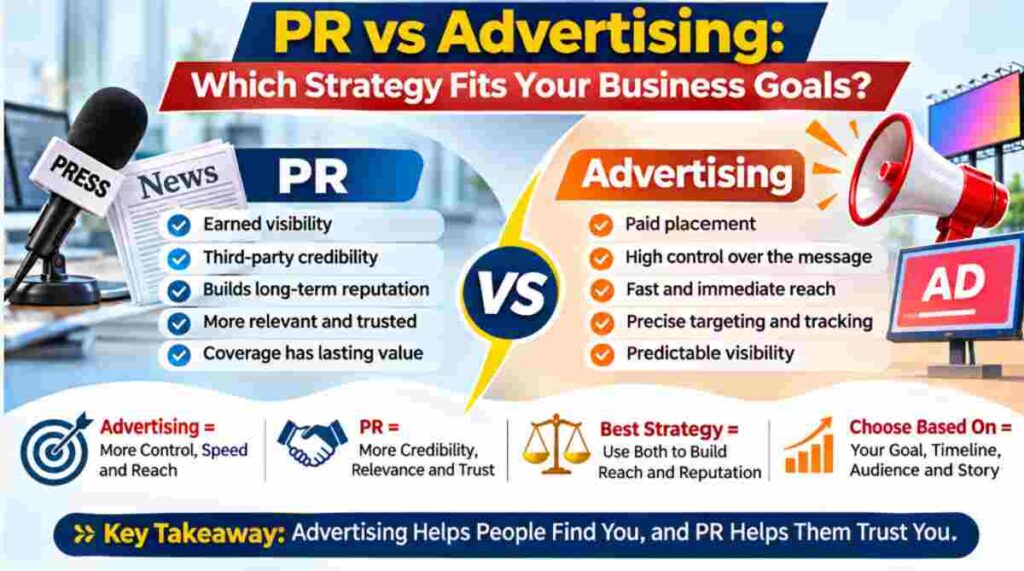
In short: advertising means you pay for placement, while PR means you earn visibility through relationships, credibility and relevance. Advertising gives you more control over the message. PR gives you more third-party credibility. Neither is better in every situation. The right choice depends on your objective.
What Is Advertising?
Advertising is paid communication. You pay a platform, publisher or media owner to show your message to a chosen audience. That could be a Google search ad, a social media campaign, a banner on a news website, a billboard, a radio spot or a sponsored post.
The defining feature is simple: you pay for placement. Because you are buying the space, you decide what the message says, how it looks, where it appears and when it runs.
Key Advantages of Advertising
- Control over the message. Your headline, visuals, tone and call to action appear exactly as you wrote them.
- Control over placement and timing. You choose the platform, the audience and the schedule.
- A campaign can go live within days and start reaching people almost immediately.
- Targeting and measurement. Digital platforms let you target by location, interest and behavior, and track impressions, clicks and conversions.
- Once you set a budget, you know roughly what visibility you are buying.
Limitations of Advertising
People know an ad is an ad. Audiences are used to brands praising themselves, so paid messages often carry less credibility than independent coverage. Advertising is also rented visibility. When the budget stops, the visibility usually stops with it. Rising costs and ad fatigue can add to the pressure.
What Is Public Relations?
Public relations is the practice of building and managing a brand’s reputation through relationships with journalists, editors, influencers, industry bodies and the public. Instead of buying space, PR professionals work to earn it, through press releases, media pitches, expert commentary, interviews, thought leadership articles, events and community engagement.
With PR, you build relationships, credibility and earned visibility. When a respected publication covers your story, the audience sees it as a third-party endorsement rather than a sales pitch.
Key Advantages of PR
- Third-party credibility. Coverage in a trusted outlet carries the weight of that outlet’s reputation.
- Reputation building. PR shapes how people perceive your brand over the long term, not just what they see this week.
- A good PR story is tied to what audiences and media actually care about, which makes it more likely to be read and shared.
- Lasting value. Published coverage can keep appearing in search results, support SEO and be reused in sales and investor material.
- Crisis readiness. Strong media relationships and a trusted reputation help a brand respond when something goes wrong.
Limitations of PR
PR gives you less control. A journalist decides whether to cover your story, what angle to take and what to include. Results take longer and are harder to guarantee, and the impact can be harder to measure than a click or a conversion. PR also depends on having something genuinely newsworthy to say.
PR vs Advertising: The Core Differences
| Factor | Advertising | PR |
| Cost model | Pay for placement | Earn coverage through relationships and storytelling |
| Control | High control over message and placement | Lower control; editors shape the final story |
| Credibility | Lower; audiences know it is paid | Higher; third-party validation |
| Speed | Fast | Slower, builds over time |
| Focus | Promotion and response | Reputation, relevance and trust |
| Longevity | Ends when spending ends | Coverage can keep delivering value |
The comparison comes down to a trade-off. Advertising offers more control over the message and placement. PR offers more emphasis on reputation, relevance and third-party credibility.
When Should You Choose Advertising?
Advertising is usually the stronger choice when your goals are immediate and measurable. Consider it when you want to:
- Launch a product or offer quickly and need visibility right away.
- Drive direct actions such as sign-ups, purchases, app downloads or bookings.
- Reach a precisely defined audience by location, demographic or interest.
- Promote a time-sensitive campaign, such as a seasonal sale or event.
- Repeat a consistent message across channels to build recall.
If you need controlled, scalable, trackable reach, paid placement is hard to beat.
When Should You Choose PR?
PR is usually the stronger choice when trust and reputation are at the heart of your goal. Consider it when you want to:
- Build credibility for a new or lesser-known brand.
- Position leaders as industry experts through interviews, bylines and commentary.
- Announce milestones, such as funding, partnerships, awards or expansions.
- Manage reputation or respond to negative news.
- Strengthen search visibility and authority with quality coverage on reputable sites.
If your audience needs to believe you before they buy from you, PR does work that ads alone cannot.
Why the Best Brands Use Both
The choice is rarely either/or. Advertising and PR often reinforce each other.
PR can create credibility and media attention, and advertising can amplify that coverage to a wider audience. A strong press feature can be promoted through paid social. Meanwhile, advertising can keep a brand visible between news moments, while PR makes sure the brand’s name carries trust when people see it.
Think of it this way: advertising helps people find you, and PR helps them trust you. A brand with only ads may reach many people but struggle to be believed. A brand with only PR may be respected but not seen widely or quickly enough. Together they cover both reach and reputation.
How to Decide: Questions to Ask
Before committing budget, ask yourself:
- What is the main objective? Immediate sales point toward advertising. Reputation and trust point toward PR.
- What is the timeline? Short windows favor ads. Long-term positioning favors PR.
- How much message control do we need? If exact wording and placement are non-negotiable, advertising offers that.
- Is our audience skeptical? Skeptical or high-consideration buyers respond well to third-party validation.
- Do we have a real story? PR depends on newsworthiness. Without one, start by building it.
- How will we measure success? Clicks and conversions suit ads. Coverage quality, share of voice, sentiment and referral traffic suit PR.
Common Mistakes to Avoid
- Expecting PR to behave like advertising. Earned coverage cannot be guaranteed or scripted, so judge it on credibility and reputation, not just speed.
- Expecting ads to build deep trust. Ads can create awareness, but trust usually needs more than paid messaging.
- Ignoring the objective. Choosing a channel because competitors use it, rather than because it fits your goal, wastes budget.
- Treating them as competitors. The strongest strategies integrate both.
Final Thoughts
PR and advertising are two different tools for two different jobs. Advertising buys you control, speed and precision. PR earns you credibility, relevance and trust. Both can be powerful.
The real question is not which one is better. It is which one fits the objective. Start with what you need to achieve, whether that is sales, awareness, authority or reputation, and let that decide where your time and budget go. For most brands, the answer over time will be a smart combination of both.