Madhya Pradesh Sets its Sights to Become Child Marriage-Free Through Collective Efforts and Coordinated Action
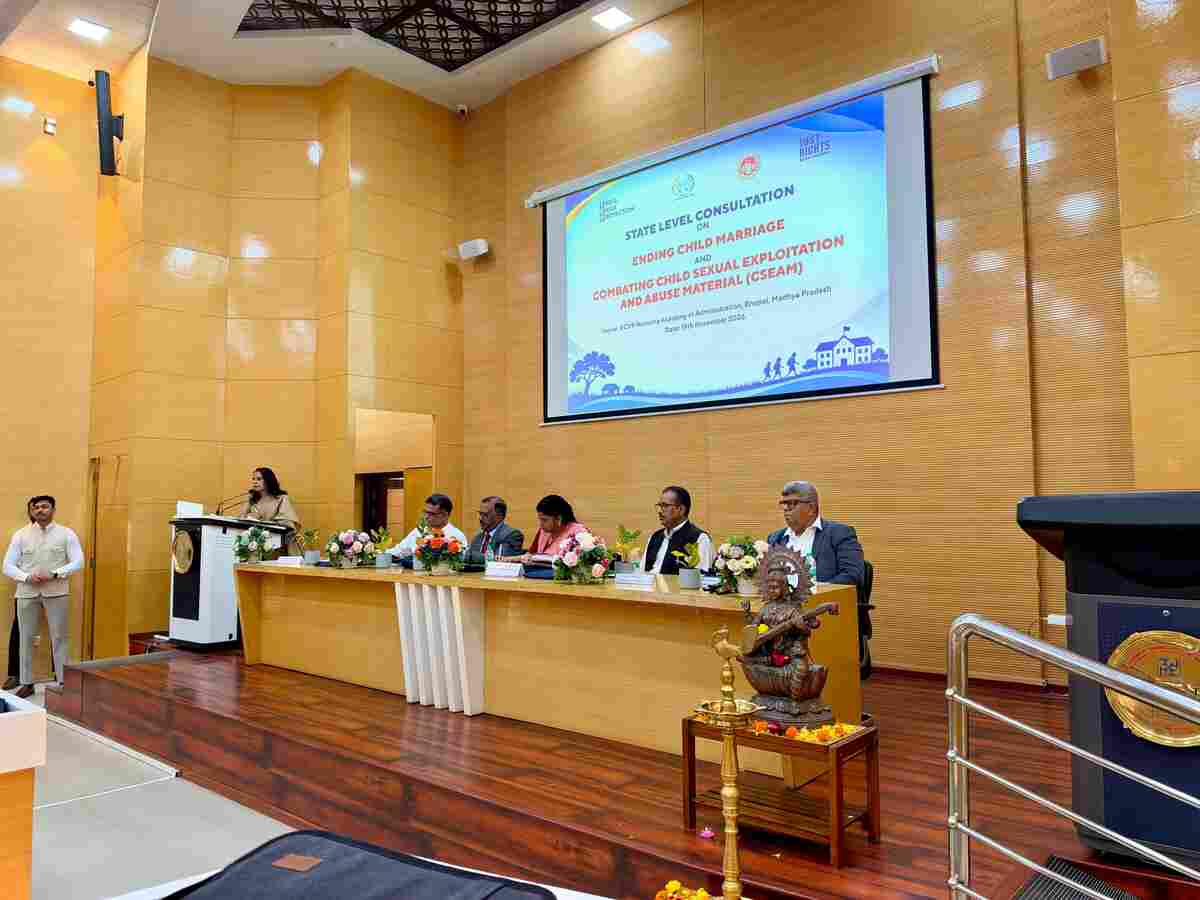
Emphasising the need for stronger interdepartmental coordination, effective implementation of laws and greater accountability, Madhya Pradesh Human Rights Commission Chairperson Dr Awadhesh Pratap Singh said that concerted efforts were essential to eliminate child marriage.
“Child marriage is a serious violation of the rights of children. Therefore, we must all come together to protect children so that future generations can be educated, remain safe and live with dignity,” he said.
Dr. Singh was speaking at a state-level consultation on “Ending Child Marriage and Combating Child Sexual Exploitation and Abuse Material (CSEAM)” in Bhopal. The consultation was jointly organised by the Madhya Pradesh Commission for Protection of Child Rights, India Child Protection (ICP) and Just Rights for Children (JRC), India’s largest civil society network working for the protection of children.
All stakeholders attending the programme discussed the need for stronger coordination, accountability and preventive strategies to address the issues of child marriage and CSEAM.
The first session focused on “An Overview of the Status of Child Marriage in the State and the Way Forward”. The second session deliberated on the implementation of Supreme Court directions to strengthen reporting mechanisms and law enforcement, and promote prevention in cases involving child sexual exploitative and abuse material (CSEAM).
Discussing CSEAM, MP Commission for Protection of Child Rights Chairperson Dr Nivedita Sharma said, “If a video containing child sexual exploitative and abuse material is found on a mobile phone, it is also important to discuss how long it has been there, how many times it has been viewed and how many times it has been forwarded. It is wrong to assume that such a video has appeared on the phone automatically and that this would not fall under the category of cybercrime. If such an incident occurs, it is important to report it. Only then will we be fulfilling our duty. Otherwise, it will be difficult to curb cases involving CSEAM.”
Ravi Kant, National Convenor of Just Rights for Children, said, “Ending child marriage is not the responsibility of the government or administration alone. Society as a whole must come together and take action. From religious leaders, teachers and panchayat representatives to people providing services related to weddings, everyone must pledge not to be part of any child marriage and to inform the administration as soon as they learn of such an incident. Only when society recognises child marriage not as a tradition but as a violation of children’s rights and a criminal offence under the law, and stands up against it, can this crime be eradicated at its roots.”
Just Rights for Children, National Secretary, Manish Sharma said, “Madhya Pradesh has stringent laws and effective policies to eliminate child marriage and a government that has clearly demonstrated its strong political will. The government is continuously running campaigns to raise awareness and prevent this crime. We believe that when the government, administration and civil society organisations work together with a shared commitment, the fight against child marriage can be taken to a decisive stage. We are confident that these collective efforts can help achieve the goal of making Madhya Pradesh a child marriage-free state by 2030.”
Other key officials who attended the consultation included MP Commissioner for Persons with Disabilities Ajay Khemaria, Deputy Inspector General of Police at the State Cyber Headquarters Dr Vineet Kapoor, Suresh Tomar from the State Commission for Women, and Professor Deepal Singh of National Law University, Bhopal, Women and Child Development Department Joint Director Amitabh Awasthi,representatives from the Panchayat Department, and all JRC partner organisations from the state.